
Autumn Foliage in Korea: Best Places and Dates
2026 Korea autumn foliage peak dates by mountain from the Korea Forest Service forecast, plus how to plan Seoraksan, Naejangsan and Seoul viewing trips.
Contents
- Key takeaways
- When the leaves peak in 2026
- Best places by region
- How to plan your trip
- Practical tips for viewing
- Common mistakes
- FAQ
- When is the best time to see autumn leaves in Korea in 2026?
- What is the difference between first color and peak?
- Do I need a reservation to hike Seoraksan or Naejangsan in autumn?
- Is Seoul good for autumn foliage?
- Sources
Korea’s autumn colors usually peak from late October into early November. The northern mountains turn first, and the south follows about one to two weeks later. The Korea Forest Service’s 2026 forecast puts the maple peak at Seoraksan on 20 October and at Hallasan on Jeju on 6 November. Treat these dates as planning guides, not fixed schedules.
Key takeaways
- 2026 Forest Service maple peaks: Seoraksan 20 Oct, Songnisan 28 Oct, Naejangsan 4 Nov and Hallasan 6 Nov.
- Color starts in the northern Gangwon mountains in early October, and most of the country peaks in late October.
- Check the latest official updates a few days before you go, because weather can shift the timing.
When the leaves peak in 2026
On 22 September 2026, the Korea Forest Service published its peak foliage forecast map. It defines “peak” as the point when about 50% of the leaves on the observed trees have changed color. The main mountain dates for maples are:
| Mountain | Region | Forecast maple peak |
|---|---|---|
| Seoraksan | Gangwon | about 20 October |
| Songnisan | Chungcheong | about 28 October |
| Naejangsan | Jeolla | about 4 November |
| Hallasan | Jeju | about 6 November |
Nationally, the forecast places ginkgo trees around 30 October and maples and oaks around 31 October. The agency said the 2026 dates run slightly later, by under one day, than the average of the previous five years.
Other forecasts may give later dates for the same mountains. That is usually because they define peak as a higher share of colored leaves, closer to 80%, or base it on visual checks of a whole mountain. Neither source is wrong. They simply measure different stages.
Best places by region
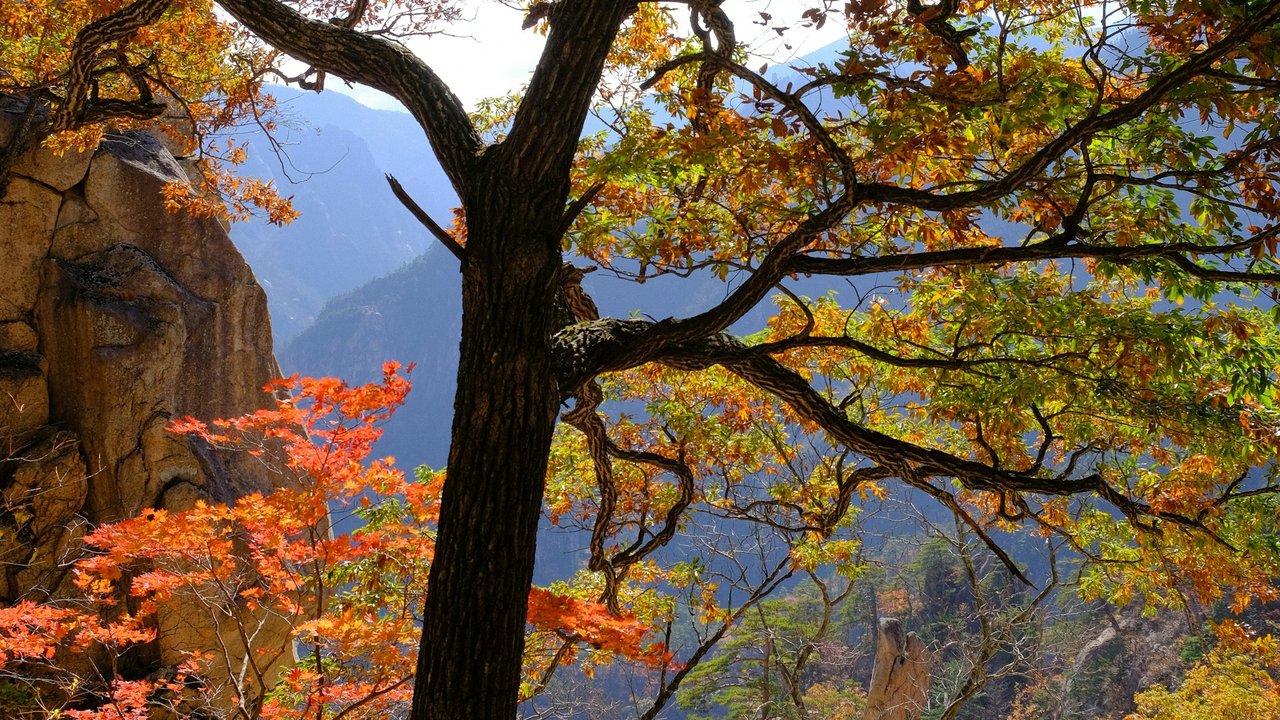
Gangwon (earliest). Seoraksan National Park has granite ridges and maple-covered valleys, and it is usually the first big name to turn. Expect heavy crowds on peak weekends.
Central Korea. Songnisan and the surrounding Chungcheong mountains follow in late October. National arboretums and botanical gardens in the capital region usually peak around the end of October or early November.
Jeolla (south). Naejangsan National Park is known for its dense maple valleys and usually peaks in early November.
Jeju. Hallasan is among the last major mountains to turn.
Seoul. For an easy day out, Bukhansan National Park on the city’s northern edge, the palace grounds and the large city parks are all reachable by subway. Central Seoul tends to color from late October into early November. Ginkgo-lined streets often stay yellow into mid-November.
How to plan your trip
- Start with the official forecast from the Korea Forest Service, then check VISITKOREA for regional travel information.
- Check trail status on the Korea National Park Service website for the park you plan to visit. Trails can close because of weather or fire risk.
- Work out transport. Seoraksan is usually reached by intercity bus from Seoul to Sokcho, then a local bus to the park entrance. Naejangsan is usually reached by train or bus to Jeongeup, then a local bus.
Worked example. Seoraksan is forecast for 20 October and Naejangsan for 4 November.
- Gap: 4 November − 20 October = 15 days.
- If you only have one trip, the last week of October is a reasonable compromise. The northern mountains are still colorful, and central Korea is near its peak.
- If you have two weekends free, you could see Seoraksan around 18–20 October and Naejangsan around 1–4 November.
Book flexible tickets and accommodation where you can, because a warm or windy week can move the best days.
Practical tips for viewing
- Go early or on weekdays. Popular trailheads and parking lots fill quickly on autumn weekends.
- Dress in layers. Mountain temperatures drop fast in the late afternoon, so carry a warm layer and wear sturdy shoes.
- Respect closures and stay on marked trails. Rangers close sections during high fire-risk periods.
- Plan city viewing for later. Palace grounds and riverside parks in Seoul look best after the mountains have peaked.
- Bring cash and a charged transit card. Some rural bus routes and small rest stops still prefer cash.
If you are still choosing your travel dates, see the best time to visit Korea by season. For city sights to combine with a foliage day, see our Seoul travel guide.
Common mistakes
- Treating one forecast date as exact, when weather and different definitions of “peak” can move it by several days.
- Going on the date of the first color reports, when the fuller display comes about one to two weeks later.
- Assuming central Seoul turns at the same time as high northern mountains, when it usually peaks later.
- Arriving at a famous trailhead on a peak-season Saturday afternoon without checking shuttles or parking.
FAQ
When is the best time to see autumn leaves in Korea in 2026?
The Korea Forest Service forecasts the main maple peaks between about 20 October (Seoraksan) and 6 November (Hallasan), with most of the country around late October. Check the latest updates shortly before you travel.
What is the difference between first color and peak?
First color describes the start of the change, when only part of a mountain has turned. The Forest Service’s peak is when about half the leaves on observed trees have changed color, usually one to two weeks later.
Do I need a reservation to hike Seoraksan or Naejangsan in autumn?
General day hiking on open trails usually does not need a reservation, but access rules, closures and some special sections are managed by the Korea National Park Service. Check the official park pages before you go.
Is Seoul good for autumn foliage?
Yes. Bukhansan, palace grounds, large parks and ginkgo-lined streets are easy to reach by subway, and the city usually peaks from late October into early November.
Sources
- Korea Forest Service, official English website: https://english.forest.go.kr/
- Korea National Park Service, official website with park and trail information: https://www.knps.or.kr/
- Korea Tourism Organization, VISITKOREA official English website: https://english.visitkorea.or.kr/
Last checked: 2026-10-10
Related posts
Korea SIM Card vs eSIM vs Pocket Wi-Fi
eSIM, tourist SIM card or pocket Wi-Fi for Korea? How each works, when you need a local number, and which suits solo travelers, couples and groups.
K-ETA and Korea Entry Requirements (2026 Guide)
Do you need a K-ETA for Korea in 2026? How the temporary exemption works, what the free e-Arrival Card is, and how to avoid fake agency sites.
Incheon Airport to Seoul: AREX, Bus or Taxi
AREX Express, All-Stop train, airport bus or taxi from Incheon Airport to Seoul: approximate times, fares and which one fits your hotel and arrival time.

Money in Korea: Cards, Cash Exchange and T-money
How foreign cards, cash exchange, Global ATMs and T-money transit cards work for visitors to Korea, plus the fee traps to avoid on your first day.
Collaboration & consulting: [email protected]
More in Korea Guide: Export to Korea: Market Guide