
Seoul Subway and Bus Guide for First-Timers
Seoul subway and bus guide for first-timers: 2026 fares, T-money, Climate Card passes after the 1 Oct changes, transfers and common mistakes.
Contents
- Key takeaways
- How much does the Seoul subway and bus cost?
- Is the Climate Card worth it for a visitor?
- How do transfers work in Seoul?
- Which bus should I take, and how do I find my way?
- What mistakes do first-time riders make?
- FAQ
- How much is the Seoul subway fare in 2026?
- Is the Climate Card worth it for a short visit?
- Can I still buy a 30-day Climate Card?
- Can I use a foreign credit card for Seoul transport?
- Do I need to speak Korean to ride the Seoul subway?
- Sources
The easiest way for a first-time visitor to get around Seoul is a rechargeable transit card used on both the subway and city buses. One card pays for both, transfers between them are discounted, and signs and announcements at major stations are in English as well as Korean.
Key takeaways
- The adult subway base fare is 1,550 KRW with a transit card (1,650 KRW for a single-journey ticket), according to the Seoul city subway page.
- Climate Card short-term passes (1 to 7 days) give unlimited rides in Seoul, but coverage was narrowed to Seoul on 1 October 2026, and the 30-day Climate Card has been discontinued.
- Tap your card when you get on and when you get off, or you can lose your transfer discount.
How much does the Seoul subway and bus cost?
An adult subway ride costs 1,550 KRW with a transit card and a Seoul city (trunk or branch) bus costs 1,500 KRW, according to the Seoul Metropolitan Government. Green local village buses are cheaper, and single-journey subway tickets cost 100 KRW more than the card fare.
Subway fares. Since June 2025 the adult subway base fare has been 1,550 KRW with a card and 1,650 KRW for a single-journey ticket, covering the first 10 km, with 100 KRW added for every further 5 km (Seoul subway page). Single-journey tickets are also less convenient, because you buy one for every trip.
Bus fares. On the Seoul bus page, the adult card fare is 1,500 KRW for blue trunk and green branch buses and 1,200 KRW for local (village) buses, in the fare table dated August 2023. Fares are adjusted from time to time, so check the official page before you travel.
Early-morning discount. Both official pages list a 20% discount on the first ride before 6:30 AM when you pay by card (owl/night buses excluded).
T-money and similar cards. You can buy a T-money card at convenience stores and station machines; the price depends on the design. You recharge it with cash at station machines or convenience stores, and it works on the subway, city buses and many taxis. Our guide to money in Korea, cards and T-money covers payment options in more detail.
Discounts. Children and teenagers pay reduced fares. Free rides for seniors apply to eligible Korean residents, not to foreign visitors.
Is the Climate Card worth it for a visitor?
Usually only if you stay two or more days and make four or more separate trips a day inside Seoul. For a single day, the 3,000 KRW card purchase and free transfers on pay-as-you-go mean a regular T-money card often comes out cheaper.
Seoul’s Climate Card short-term passes give unlimited rides for a chosen number of days. Prices on the official Climate Card page are:
- 1 day: 5,000 KRW
- 2 days: 8,000 KRW
- 3 days: 10,000 KRW
- 5 days: 15,000 KRW
- 7 days: 20,000 KRW
You first buy a physical card for 3,000 KRW at a subway station machine, then charge a pass onto it. The pass starts on the day you charge it and cannot be loaded in advance. International credit and debit cards can be used to buy and recharge Climate Cards since 20 March 2025, according to the city’s English page.
The 30-day pass is gone. The 30-day prepaid Climate Card could only be recharged until 31 August 2026 and has been replaced by the Climate Pass, which is available only to Seoul residents. Visitors can still use the 1-, 2-, 3-, 5- and 7-day short-term passes (Climate Card page, discontinuation FAQ, Korean).
What changed on 1 October 2026. The pass now covers subway sections inside Seoul and Seoul-licensed city and village buses (including night and circular buses), plus getting off the Airport Railroad at Incheon Airport T1/T2. Sections in Gimpo, Goyang, Gwacheon, Guri, Seongnam, Hanam and Namyangju that used to be included are no longer covered. The Sinbundang Line, GTX, airport and metropolitan buses, and buses licensed by other cities are also excluded (Seoul notice, Korean).
Exiting outside the area. If you tap in inside the pass area and tap out at a subway station outside it, for example Jongno 3-ga to Indeogwon in Gyeonggi-do, the Climate Card cannot be used for that trip and you are charged the fare.
Worked example. Count separate trips, not vehicles: a subway-to-bus transfer within the time limit is charged as one trip with no new base fare. Four separate subway trips in one day cost 4 × 1,550 = 6,200 KRW on pay-as-you-go. A first-time visitor’s 1-day pass costs 5,000 + 3,000 (card) = 8,000 KRW, so it does not pay off. Over three days with four trips a day, pay-as-you-go costs 12 × 1,550 = 18,600 KRW, while a 3-day pass plus the card costs 10,000 + 3,000 = 13,000 KRW, saving 5,600 KRW. If you plan a day trip outside Seoul, the pass will not cover it.
How do transfers work in Seoul?
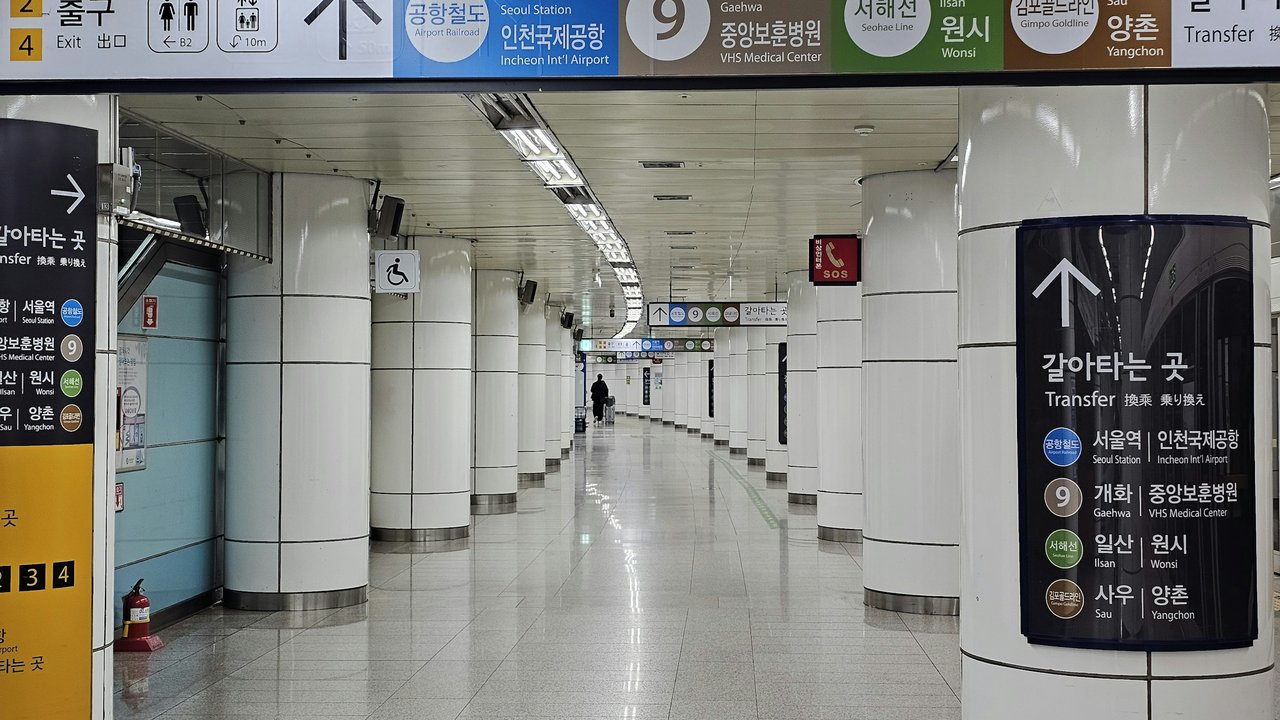
Tap the same card when you get off one vehicle and when you board the next, and the ride is treated as one trip. You must board within 30 minutes of getting off (60 minutes between 9 PM and 7 AM), and you can transfer up to 4 times (5 boardings).
You pay the highest base fare among the vehicles used plus any extra distance charges. Re-boarding the same bus or the same route does not count as a transfer, so you pay the base fare again. These rules come from the Seoul bus page and the Seoul subway page.
Which bus should I take, and how do I find my way?
Blue buses run long trunk routes, green buses serve local neighborhoods, and yellow buses run short loops downtown. Red buses are express (metropolitan) buses to nearby cities and aren’t covered by the Climate Card.
Navigation. Map apps that show live Korean transit data, such as Naver Map or KakaoMap, are usually more accurate for buses than global map apps. Station names are shown in Korean and English, and many stations have numbered exits that make meeting points easy.
If you plan to leave the city, use a regular T-money balance for trips outside the Climate Card area. For longer trips, see our KTX and SRT booking guide; for getting in from the airport, see Incheon Airport to Seoul.
What mistakes do first-time riders make?
The most common are buying a single-journey ticket for every ride and forgetting to tap out. Others assume the Climate Card still covers nearby cities.
- Buying a single-journey ticket for every ride instead of a rechargeable card.
- Forgetting to tap out when leaving a bus, which can cancel your transfer discount.
- Assuming the Climate Card still covers nearby Gyeonggi cities or the Sinbundang Line; since 1 October 2026 it covers Seoul only.
- Tapping out at a station outside Seoul on a Climate Card and being charged the fare.
- Looking for a 30-day Climate Card; visitors can only buy 1- to 7-day passes now.
- Relying only on a global map app for bus routes instead of an app with local live data.
To plan your overall spending, see our Korea trip cost and daily budget guide.
FAQ
How much is the Seoul subway fare in 2026?
The adult base fare is 1,550 KRW with a transit card or 1,650 KRW for a single-journey ticket for the first 10 km, plus 100 KRW per extra 5 km. The first card ride before 6:30 AM is 20% off.
Is the Climate Card worth it for a short visit?
For a single day it usually is not: with the 3,000 KRW card, a 1-day pass costs 8,000 KRW, more than four separate trips on T-money (6,200 KRW). It pays off mainly over two or more days with four or more separate trips a day inside Seoul, because transfers are already counted as one trip on pay-as-you-go.
Can I still buy a 30-day Climate Card?
No. The 30-day Climate Card was discontinued and replaced by the Climate Pass for Seoul residents only. Visitors can buy 1-, 2-, 3-, 5- and 7-day short-term passes.
Can I use a foreign credit card for Seoul transport?
Seoul’s official page says Climate Cards can be bought and recharged with international credit and debit cards since 20 March 2025. T-money is still most reliably recharged with cash at station machines or convenience stores.
Do I need to speak Korean to ride the Seoul subway?
No. Major stations have English signs and announcements, and route-planning apps with English menus make it easy to find the right line and exit.
Sources
- Seoul Metropolitan Government, Climate Card official English page: https://english.seoul.go.kr/policy/transportation/climate-card/
- Seoul Metropolitan Government, Climate Card short-term pass notice (Korean): https://news.seoul.go.kr/traffic/archives/510651
- Seoul Metropolitan Government, Climate Card short-term pass FAQ (Korean): https://news.seoul.go.kr/traffic/public/climatecard-faq/faq-short
- Seoul Metropolitan Government, 30-day Climate Card discontinuation FAQ (Korean): https://news.seoul.go.kr/traffic/public/climatecard-faq/faq-stop
- Seoul Metropolitan Government, subway fares and transfers (English): https://english.seoul.go.kr/policy/transportation/modes-of-transport/subway/
- Seoul Metropolitan Government, bus fares and transfer rules (English): https://english.seoul.go.kr/policy/transportation/modes-of-transport/bus/
- Korea Tourism Organization, VISITKOREA official English website: https://english.visitkorea.or.kr/
Last checked: 2026-10-14
Related posts
Money in Korea: Cards, Cash Exchange and T-money
How foreign cards, cash exchange, Global ATMs and T-money transit cards work for visitors to Korea, plus the fee traps to avoid on your first day.
Korea Travel Apps: Which Should You Install Before You Fly?
The apps that make a first trip to Korea easier: local map apps, taxi apps, translation, and official train booking, plus what to set up before you fly.
Business Trip to Seoul: What to Sort Out Before You Fly
A business trip checklist for Seoul: entry forms, meeting etiquette, business cards, airport transfer, daily logistics and a simple local cost estimate.
Jeju Island for First-Timers: Where Should You Stay and Go?
A first-timer guide to Jeju Island: where to stay, the main areas, Hallasan rules, buses versus rental cars, and what drivers need before renting.
Collaboration & consulting: contact@silenseatrading.com
More in Korea Guide: Export to Korea: Market Guide