
Vegetarian, Vegan & Halal Food in Korea: What to Eat?
How vegetarian, vegan and halal travelers can eat well in Korea: official Muslim-friendly categories, temple food, what to ask for, and how to check.
Contents
- Key takeaways
- How Muslim-friendly restaurants are classified
- Vegetarian and vegan eating in Korean cuisine
- Practical steps
- Common mistakes
- FAQ
- How do I find halal-certified restaurants in Seoul?
- Is Korean temple food vegan?
- Can vegetarians eat bibimbap in Korea?
- Can the 1330 hotline help with dietary needs?
- Sources
Vegetarian, vegan and halal travelers can eat well in Korea, but it takes some planning, especially outside Seoul and Busan. Many Korean dishes look vegetable-based yet use fish sauce, anchovy broth or meat stock, and halal status has to be checked restaurant by restaurant using official sources.
Key takeaways
- Korea’s official tourism site sorts Muslim-friendly restaurants into categories such as halal certified, self-certified, Muslim friendly and pork free; these are not the same thing.
- Korean temple food is the most reliable fully plant-based option, while many everyday dishes need a clear request.
- Never assume a restaurant is halal certified; check the current official lists and ask staff before ordering.
How Muslim-friendly restaurants are classified
The Korea Tourism Organization (KTO) groups Muslim-friendly restaurants into categories that tell you different things:
- Halal certified. Certified by a recognized halal certification body, such as the Korea Muslim Federation (KMF).
- Self-certified. The owner, usually Muslim, states that the food is halal, but there is no third-party certificate.
- Muslim friendly. Some halal menu items are offered, but the restaurant may also serve other food or alcohol.
- Pork free. No pork is served, but the restaurant does not claim to be halal, and alcohol may be sold.
Official guides may also use symbols for details such as alcohol-free premises or whether a halal menu needs advance booking.
Lists change as restaurants open, close or renew certificates. Treat a restaurant as halal certified only if it appears that way on the current KTO or KMF information when you visit, and confirm with staff. A “pork free” or “halal” sign on the door alone is not proof of certification. The 1330 Korea Travel Hotline can help in English if you need to check information.
Vegetarian and vegan eating in Korean cuisine
Temple food. Korean Buddhist temple food (sachal eumsik) uses no meat or fish and traditionally avoids five pungent plants, including garlic and green onion. Temple-style set meals are usually fully plant-based, making them the safest choice for vegans. Some restaurants adjust recipes for general diners, so say if you want the strict version. A temple stay is another way to try it.
Everyday dishes. Several common dishes can work if you ask clearly:
- Bibimbap: ask for no meat and no egg, and check whether the sauce contains fish products.
- Vegetable pancakes: the batter may contain egg or seafood.
- Tofu stews: often made with anchovy or seafood broth, so ask before ordering.
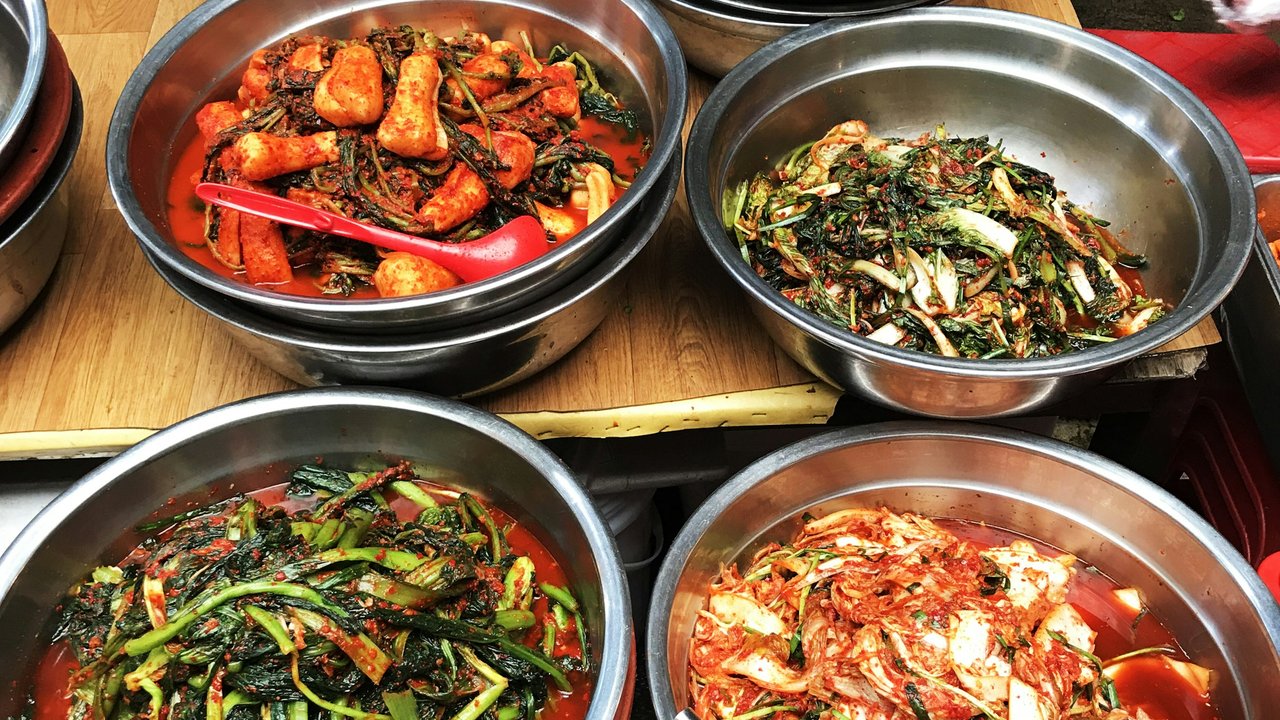
- Kimchi: frequently made with fish sauce or salted shrimp, although vegan kimchi exists.
Hidden animal products are the main challenge. Anchovy stock, fish sauce, salted shrimp and beef stock are common bases for soups, stews and side dishes.
Plant-based restaurants. Seoul has a growing number of vegetarian and vegan restaurants, and official tourism materials increasingly cover plant-based dining. Use current listings and recent information rather than older lists.
Convenience stores. Plain rice balls, fruit, nuts, soy milk and some snacks can help in a pinch, but read ingredient labels, because many packaged foods contain meat extracts or seafood seasoning.
Worked example (illustrative price). If a temple-style set lunch costs 18,000 KRW per person, two people pay 18,000 × 2 = 36,000 KRW. Set menus usually include rice, soup and several vegetable side dishes, but prices vary widely, so check the menu.
Practical steps
- Before your trip, check the KTO Muslim-friendly travel page and KMF information for current halal and Muslim-friendly listings.
- In Seoul, the area around the Seoul Central Mosque in Itaewon has many Muslim-friendly options, but status still needs checking for each restaurant.
- Learn or save a few short phrases to show staff, such as “no meat, no fish, no egg” or “no pork, no alcohol”, ideally written in Korean.
- Ask about broth and sauces, not just the main ingredients.
- For market meals, see Seoul traditional markets, and for how ordering works, see Korean restaurant etiquette.
Common mistakes
- Treating a “pork free” sign as halal certification.
- Ordering a standard dish without asking about meat broth, fish sauce or egg.
- Relying on old blog lists instead of current official information.
- Assuming every temple-food restaurant follows the strict no-garlic, no-onion rule for all dishes.
FAQ
How do I find halal-certified restaurants in Seoul?
Start with the Korea Tourism Organization’s Muslim-friendly travel information and the Korea Muslim Federation. Then confirm with the restaurant that its certification is still valid before you eat.
Is Korean temple food vegan?
Traditional temple food uses no meat or fish and avoids pungent plants such as garlic, so it is usually plant-based. Some restaurants adapt recipes, so ask for the strict version if you need it.
Can vegetarians eat bibimbap in Korea?
Usually yes, if you ask for it without meat or egg and check that the sauce and any broth contain no fish products. Cross-contact is possible in busy kitchens.
Can the 1330 hotline help with dietary needs?
Yes, the 1330 Korea Travel Hotline offers help in English and can point you to official information about Muslim-friendly and vegetarian options.
Sources
- Korea Tourism Organization, VISITKOREA Muslim-friendly travel page: https://english.visitkorea.or.kr/svc/thingsToDo/subMuslimFriendly.do
- Korea Muslim Federation, official website (Korean): https://www.koreaislam.org
- Korea Tourism Organization, VISITKOREA official English website: https://english.visitkorea.or.kr/
Hero photo: Giselle Herrera on Unsplash (Unsplash License)
Last checked: 2026-10-10
Related posts

Korean Jjimjilbang Etiquette: What Should First-Timers Know?
A step-by-step guide to using a Korean jjimjilbang: check-in, bathing rules, shared sauna rooms, overnight stays, tattoos and etiquette for first-timers.
Seoul Traditional Markets: Which One Should You Visit First?
A first-timer's guide to Seoul's traditional markets, including Gwangjang and Namdaemun: what each is best for, opening hours, food, cash and etiquette.
Korean Restaurant Etiquette: How Do You Order and Pay?
Korean restaurant basics for first-timers: getting seated, calling staff, ordering by portion, sharing side dishes, paying at the counter, and no tipping.

Korea Travel Apps: Which Should You Install Before You Fly?
The apps that make a first trip to Korea easier: local map apps, taxi apps, translation, and official train booking, plus what to set up before you fly.
Collaboration & consulting: silenseatrading@gmail.com
More in Korea Guide: Export to Korea: Market Guide