
Seoul Traditional Markets: Which One Should You Visit First?
A first-timer's guide to Seoul's traditional markets, including Gwangjang and Namdaemun: what each is best for, opening hours, food, cash and etiquette.
Contents
- Key takeaways
- Gwangjang Market: Seoul’s food market
- Namdaemun Market: the biggest variety
- Other markets and how to choose
- Practical tips
- Common mistakes
- FAQ
- Is Gwangjang Market open on Sundays?
- Do I need cash at Seoul traditional markets?
- Can vegetarians eat at Gwangjang Market?
- How long should I spend at Namdaemun Market?
- Sources
Seoul’s traditional markets are the best places for first-time visitors to eat local dishes cheaply and see everyday commerce up close. Go to Gwangjang Market if your priority is food, and to Namdaemun Market if you want to browse a huge range of goods; smaller neighborhood markets are quieter alternatives.
Key takeaways
- Gwangjang Market is best for food, and its food street stays open later than the rest of the market, including on Sundays.
- Namdaemun Market is best for shopping variety, but many shops close on Sundays and hours differ from shop to shop.
- Bring small bills, ask the price before you order, and check official hours before a special trip.
Gwangjang Market: Seoul’s food market
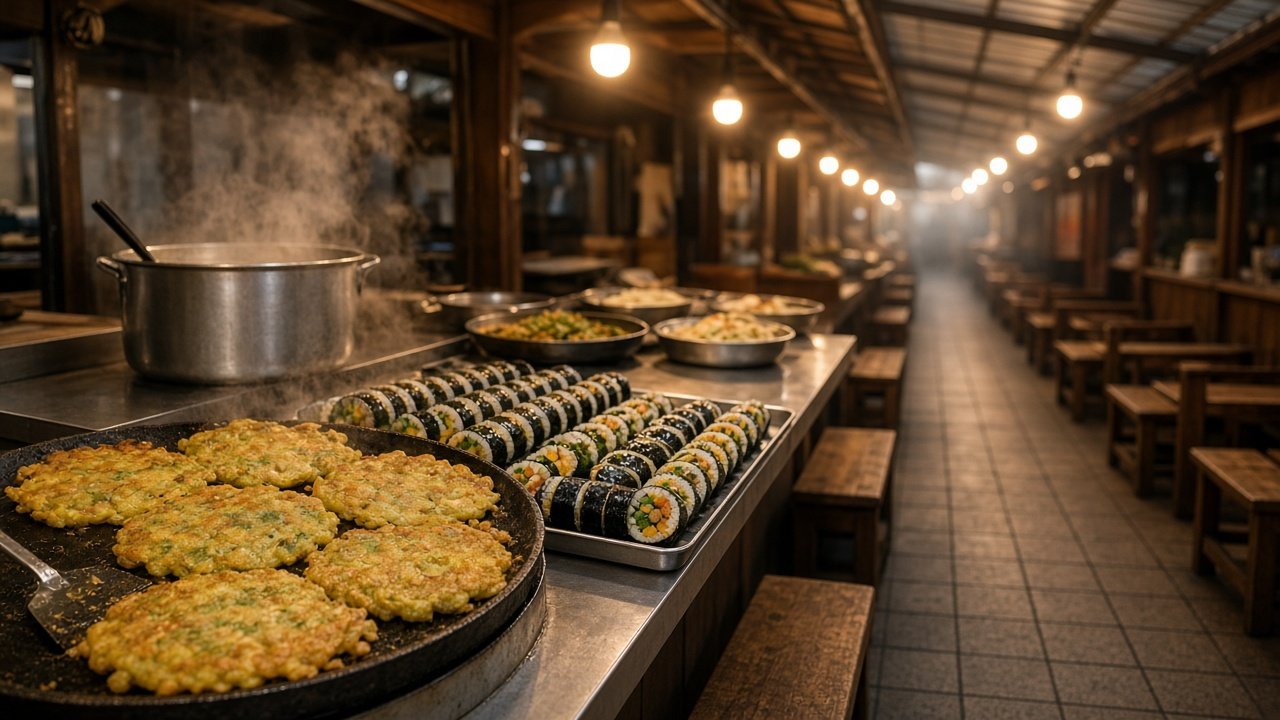
Gwangjang is one of Seoul’s oldest and best-known traditional markets. Most of the complex is still a working wholesale market for fabrics, bedding, dried seafood, produce and household goods. Visitors mostly come for the covered food alleys in the middle, where rows of stalls cook in front of you and diners sit on benches at the counter.
What to eat. Typical market dishes include mung bean pancakes (bindaetteok), small seaweed rice rolls (mayak gimbap), noodle soups, tteokbokki and dumplings. Our list of 20 Korean foods to try on your first trip explains what these dishes are.
Hours. According to the official tourism listing, general shops open roughly 09:00–18:00 and the food street roughly 09:00–23:00. General shops close on Sundays, while the food street is listed as open all year. Individual stalls set their own days off.
Getting there. Gwangjang sits between Jongno 5-ga Station (Line 1) and Euljiro 4-ga Station (Lines 2 and 5), close to the Cheonggyecheon stream.
Worked example (illustrative prices). Two people share one mung bean pancake at 7,000 KRW and two plates of mini rice rolls at 4,000 KRW each: 7,000 + (2 × 4,000) = 15,000 KRW, or 7,500 KRW per person. Prices differ between stalls and change over time, so check the menu board before ordering.
Namdaemun Market: the biggest variety
Namdaemun Market sits next to Sungnyemun Gate in central Seoul and has been a trading area for centuries. It is a dense maze of alleys and multi-story arcades selling clothing, children’s wear, eyeglasses, kitchenware, accessories, ginseng, dried goods and souvenirs, many of them sold both wholesale and retail.
Hours. Opening times vary widely. According to the official tourism listing, wholesale sections trade from about 23:00 to 04:00, while retail shops usually open from morning to early evening. Many shops close on Sundays, so a weekday visit is safest.
Getting there. Hoehyeon Station on Line 4 is right next to the market, and Seoul Station is a short walk away.
Food. Small food alleys serve simple dishes such as noodle soups, braised fish and hotteok, a sweet filled pancake. Portions are often generous.
Other markets and how to choose
- Tongin Market near Gyeongbokgung is a small neighborhood market with food stalls. Check opening days before you go.
- Noryangjin Fisheries Wholesale Market is a large seafood market; check current hours before visiting.
- Mangwon Market in western Seoul is a neighborhood market with snack stalls.
Pick Gwangjang for street food, Namdaemun for shopping, and a neighborhood market if you want a calmer, more local atmosphere. If you avoid meat or fish, see vegetarian, vegan and halal food in Korea, because many market broths and batters contain animal products.
Practical tips
- Visit on a weekday morning or early afternoon for shorter waits.
- Carry small bills and coins; many stalls take cards now, but not all.
- Ask the total price before you sit down or order, especially if there is no menu board.
- Bargaining is more accepted for non-food goods bought in quantity than for prepared food.
- Do not block narrow aisles to take photos, and ask before photographing vendors.
- For help in English, the 1330 Korea Travel Hotline can check opening information.
Common mistakes
- Visiting on a Sunday and expecting all shops at Namdaemun or Gwangjang’s general sections to be open.
- Filling up at the first stall and missing the variety further down the alley.
- Relying only on cards at small stalls that prefer cash.
- Assuming every stall keeps the hours shown on a tourism listing.
FAQ
Is Gwangjang Market open on Sundays?
The general shops are listed as closed on Sundays, but the food street is listed as open all year. Individual stalls may still take days off, so expect some closures.
Do I need cash at Seoul traditional markets?
Many stalls accept cards, but small food stalls and some shops still prefer cash. Carrying a modest amount in small bills makes paying easier.
Can vegetarians eat at Gwangjang Market?
Some dishes, such as certain vegetable pancakes, can be meat-free, but batters, sauces and broths may contain seafood or meat. Ask clearly at each stall and be prepared for limited choice.
How long should I spend at Namdaemun Market?
One to two hours is enough for most first-time visitors to see the main retail alleys and have a snack. Serious shoppers can easily spend longer.
Sources
- Korea Tourism Organization, VISITKOREA official page for Gwangjang Market: https://english.visitkorea.or.kr/svc/whereToGo/locIntrdn/rgnContentsView.do?vcontsId=106345
- Korea Tourism Organization, VISITKOREA official page for Namdaemun Market: https://english.visitkorea.or.kr/svc/whereToGo/locIntrdn/rgnContentsView.do?vcontsId=106358
- Korea Tourism Organization, VISITKOREA official English website: https://english.visitkorea.or.kr/
Last checked: 2026-10-29
Related posts
20 Korean Foods to Try on Your First Trip
Twenty easy-to-order Korean dishes for first-time visitors, from bibimbap and barbecue to street snacks, with spice notes and a sample order.
Korean Jjimjilbang Etiquette: What Should First-Timers Know?
A step-by-step guide to using a Korean jjimjilbang: check-in, bathing rules, shared sauna rooms, overnight stays, tattoos and etiquette for first-timers.
Vegetarian, Vegan & Halal Food in Korea: What to Eat?
How vegetarian, vegan and halal travelers can eat well in Korea: official Muslim-friendly categories, temple food, what to ask for, and how to check.
Korean Restaurant Etiquette: How Do You Order and Pay?
Korean restaurant basics for first-timers: getting seated, calling staff, ordering by portion, sharing side dishes, paying at the counter, and no tipping.
Collaboration & consulting: silenseatrading@gmail.com
More in Korea Guide: Export to Korea: Market Guide